Battery backup · Master electricians
Home battery backup, wired to your panel
A battery permanently connected to your panel serves as backup power for your essential circuits. We handle the hookup, the permit when the city requires one, and the request to Hydro-Québec.
Rénoclimat: up to $4,000 toward the equipment
4.9469 Google reviews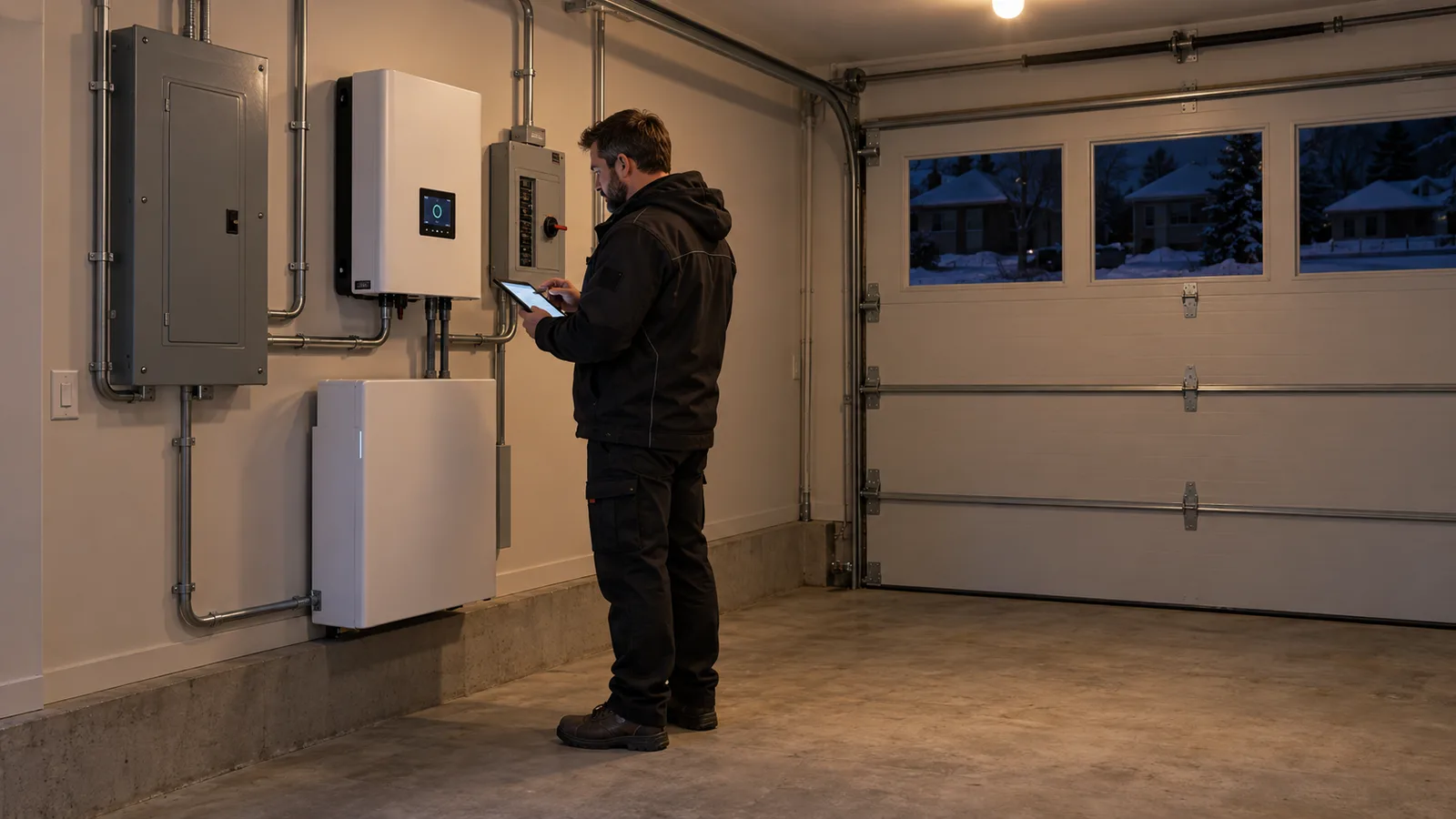
In short
STM-Électrique and backup batteries
STM-Électrique is a firm of master electricians based in Mirabel, holding RBQ licence 5815-0137-01. We install fixed batteries permanently connected to the home’s electrical panel. The job includes the connection request to Hydro-Québec and its follow-up until final authorization, the municipal permit when the city requires one, the declaration of work when it is required, and the Rénoclimat attestation form. Rénoclimat pays up to $4,000 toward the equipment of a grid-tied fixed battery of at least 5 kWh, for work done since October 1, 2026. The exact price depends on your installation and is set out in the quote, written and free: 438 542-7304 or the form at the bottom of the page.
Fixed battery or portable power station: two different devices
A fixed backup battery is a set of one or more batteries and one or more inverters, permanently connected to the home’s electrical panel. A portable power station is a large battery with an inverter and outlets, which you recharge once it is empty.
The fixed battery
Permanently tied into the panel
- It is permanently connected to the electrical panel, by a master electrician.
- The one we install is connected in parallel with the Hydro-Québec grid, which requires authorization from Hydro-Québec.
- It can receive up to $4,000 from Rénoclimat if it meets the program’s conditions.
The portable power station
Appliances plugged into it
- You plug appliances straight into it, with extension cords.
- To power circuits in the house, you need approved interconnection equipment, installed by an electrician.
- It does not qualify for Rénoclimat: portable batteries are excluded.
Capacity, voltage, winter use: our guide battery or gasoline generator (in French) compares portable power stations with a gasoline generator.
Battery or generator: how they differ
A battery stores electricity; a generator produces it. Hydro-Québec lists the battery under “Storage” among its self-generation installations: it stores energy for later use.
The fixed battery
Stored energy
- It gives back the electricity it has stored, then it has to recharge.
- The one we install is connected in parallel with the grid: Hydro-Québec’s authorization is required before it is hooked up.
- Rénoclimat: up to $4,000 toward the equipment, nothing toward the labour.
The generator
Electricity produced by an engine
- Portable: runs on gasoline, refilled during the outage, plugged into an outdoor power inlet and a manual transfer switch near the panel.
- Standby: runs on propane or natural gas, continuously; an automatic transfer switch starts it and switches the circuits over in a few seconds.
- Rénoclimat: up to $1,000 toward the labour of the master electrician who connects it, nothing toward buying the generator or the transfer switch.
- A portable generator must run outside, at least 6 metres from buildings, never in the garage.
For generators: our generator installation page, the transfer switch (in French), the automatic standby generator (in French) and our guide which generator for a house (in French).
How we connect a fixed battery
Here is the typical setup we install, based on the single-line diagram of the setup we install. It brings together the main panel, the inverter and its battery, and an emergency panel.
The main panel
The starting point
In our typical diagram, it is a 200 A, 120/240 V main service panel.
The hybrid inverter and the battery
On a 100 A breaker
The hybrid inverter is protected by a 100 A breaker, and the battery is connected to it. For Rénoclimat, this inverter must be able to power the house at the same time as the grid.
The secondary emergency panel
On a 60 A breaker
It is protected by a 60 A breaker and fitted with a 60 A, 120/240 V manual transfer switch. This is the panel that groups the critical loads to be backed up.
The meters
On the grid side
The diagram shows the Hydro-Québec meter and a smart meter. Hydro-Québec also requires a communicating-type meter.
During an outage: the emergency panel
For backup power, the single-line diagram Hydro-Québec requires shows the switching device that transfers the critical loads, the critical-loads panel and the battery.
In our setup, the critical-loads panel is the secondary emergency panel, and the switching device is its 60 A manual transfer switch. The circuits grouped in that panel are the ones that run on the battery during an outage.
How long will the battery last? It depends on the energy it stores, in kilowatt-hours, and on what the circuits you keep on draw. As a benchmark, one of the batteries we install stores about 16 kWh. The calculation starts from what you want to keep running.
Certified equipment: what Hydro-Québec requires
Hydro-Québec’s application guide for standard E.12-07 also covers batteries. Among other things, it calls for an inverter certified to UL 1741-SB, compliant with IEEE 2030.5 and fitted with a neutral terminal. For backup with a microgrid interconnection device, it adds UL 1741 CRD Multimode certification.
Based on Hydro-Québec’s application guide for standard E.12-07 (in French, version of June 15, 2026), checked on October 15, 2026.
One of the inverters we install
CSA certified
- CSA certified to C22.2 No. 107.1 and UL 1741.
- Grid support functions verified to UL 1741 SB and IEEE 1547.1-2020.
- Interoperability verified with the IEEE 2030.5-2018 protocol.
One of the batteries we install
ANSI/CAN/UL 1973 certified
- Lithium-ion battery certified to ANSI/CAN/UL 1973.
- 51.2 V and 314 Ah, or about 16 kWh.
- Charging between 3 and 55 °C, discharging between −15 and 55 °C, ambient temperature.
We do not install uncertified equipment. We also work with more than one supplier.
Rénoclimat: up to $4,000 for the battery
Since October 1, 2026, Rénoclimat has an “Adding a fixed battery” measure that pays up to $4,000. The rebate is the lesser of the amount paid for eligible equipment, before taxes, and that cap. The master electrician’s fees are not included.
You, the owner, apply, no later than 12 months after the end of the work. The application portal is under development, but the work can already be done. Applications are accepted until the budget runs out. On our side, we fill out and sign the contractor’s work compliance attestation form.
LogisVert, Hydro-Québec’s rebate, excludes energy storage equipment. And Rénoclimat cannot be combined with other assistance from the governments of Québec and Canada, tax credits included.
Among other things, the system must:
- combine batteries and inverters permanently connected to the panel;
- be at least 5 kWh;
- have a true sine wave inverter, with at least 1.2 kW continuous and 2.5 kW surge capacity;
- not be isolated from the electricity distributor’s grid;
- have an inverter that complies with Hydro-Québec standard E.12-07.
And the home must be:
- your principal residence, a duplex, a triplex or a building with at least four units, never a secondary residence;
- built and lived in for at least five years, and connected to the grid.
All the conditions and the documents to provide: our Rénoclimat 2026 guide.
Sources checked on October 15, 2026: Rénoclimat participant’s guide and what’s new page (Québec.ca, in French), LogisVert participation guide (Hydro-Québec, in French).
With or without solar panels
A battery does not need solar panels for Rénoclimat: the section of the guide that describes the measure does not require any. Hydro-Québec describes the battery as a system that lets you use electricity later, serve as backup power, or both.
Looking for a solar battery, tied to panels? Then things change. Hydro-Québec’s solar subsidy does not pay for the battery, and nothing confirms that the same project can receive both that subsidy and Rénoclimat assistance: each of the two programs limits combining.
We install solar panels ourselves, and our RBQ licence includes subcategories 11.2, 13.5 and 16. For its solar subsidy, Hydro-Québec requires subcategory 11.2 or 13.5, plus 16. The full process, from connection to net metering: solar panels and Hydro-Québec.
Home battery backup in Laval, on the North Shore, in Montréal and on the South Shore
We work from Laval to the Laurentians and from Montréal to the South Shore, from our offices in Mirabel and our warehouse in Laval.
Laval and the North Shore
Laval, Mirabel, Blainville, Saint-Eustache, Rosemère, Boisbriand, Terrebonne, Mascouche
Laurentians and Lanaudière
Saint-Jérôme, Sainte-Adèle, Sainte-Agathe-des-Monts, Mont-Tremblant, Lachute, Repentigny
Montréal and the South Shore
Montréal, Longueuil, Brossard, Boucherville and the entire South Shore
Your city is not on the list? Leave your contact details and the team will confirm whether we can travel there.
To prepare your project before our visit
- Photos of the panel. The panel with its door open, the main breaker label and an overall view of the wall.
- The electrical service. Its amperage and the panel brand, if you know them.
- The meter and the Internet. The Hydro-Québec meter must be a communicating type, and a wired Internet connection, by Ethernet cable, must be possible.
- The list of circuits to back up. What you want to keep running during an outage: it is the starting point of the calculation.
- For Rénoclimat. A house built and lived in for at least five years, and your property assessment roll, one of the documents for the application.
Learn more
Rénoclimat 2026: battery and generator
Both measures, their conditions, the documents to provide and the 12-month deadline.
Solar panels and Hydro-Québec
The connection request, the two authorizations, the tests and net metering.
Portable power stations and gasoline generators (in French)
Capacity, voltage, winter and safety: what a power station can do during an outage.
Generator installation
Portable or standby, connected by our master electricians.
The transfer switch (in French)
Manual or automatic: the part that connects a generator to the panel.
Financing
Financing available through Financeit, subject to credit approval.
Home battery backup: your questions
How long can a battery power a house during an outage?
It depends on the energy stored in the battery, in kilowatt-hours, and on what the circuits connected to the emergency panel draw. As a benchmark, one of the batteries we install stores about 16 kWh. The calculation starts from what you want to keep running.
How much does an installed backup battery cost?
Every project is different, and the exact price is set out in the quote, written and free. Rénoclimat can then pay up to $4,000 toward the eligible equipment, before taxes, but nothing toward the labour. What varies from one project to the next (battery capacity, inverter, backup power) and what the rebates cover: see our guide on solar and battery cost.
Is there a rebate for a home battery?
Yes, Rénoclimat: up to $4,000 for adding a fixed battery of at least 5 kWh, connected to the panel and to the grid, in a principal residence, a duplex, a triplex or a building with at least four units. LogisVert, Hydro-Québec’s rebate, excludes energy storage equipment.
Do I need to notify Hydro-Québec to install a battery?
Yes, if the battery is connected in parallel with the grid: Hydro-Québec’s authorization is required, and the master electrician files the request, ideally before the purchase. At STM-Électrique, we file that request and follow it up until final authorization.
Do I need solar panels to install a battery?
No. Rénoclimat does not require solar panels for the fixed battery. A battery can be used to consume electricity later, as backup power, or both.
What size battery does a house need?
For Rénoclimat, the system must be at least 5 kWh, with an inverter of at least 1.2 kW continuous and 2.5 kW surge. As a benchmark, one of the lithium-ion batteries we install stores about 16 kWh. The rest depends on the circuits you want to keep running.
Does a portable power station qualify for Rénoclimat?
No. Portable batteries are excluded: the measure covers batteries and inverters permanently connected to the electrical panel.
Can I install a home battery myself?
No. Connecting to the panel is an electrician’s job, which the Régie du bâtiment du Québec does not allow you to do yourself. The request to Hydro-Québec and the verification report fall to the master electrician, and Rénoclimat excludes work done by the owner.
Do you offer financing?
Yes, financing available through Financeit, subject to credit approval. Details are on our Financing page.
Get a quote: home battery backup
Your contact details and three quick questions. Not sure of an answer? Leave “Not sure” and we will check on site.
Home battery backup
Ready for the next outage?
A written, free quote, and the Hydro-Québec request taken care of.