Solar panels · Master electricians
Solar panel and battery installation
We install the panels ourselves, with or without a battery. The Hydro-Québec connection request is part of the job, as is the municipal permit when the city requires one.
Hydro-Québec: $1,000 per kW installed, up to 40% of the cost of the installed panels
4.9469 Google reviews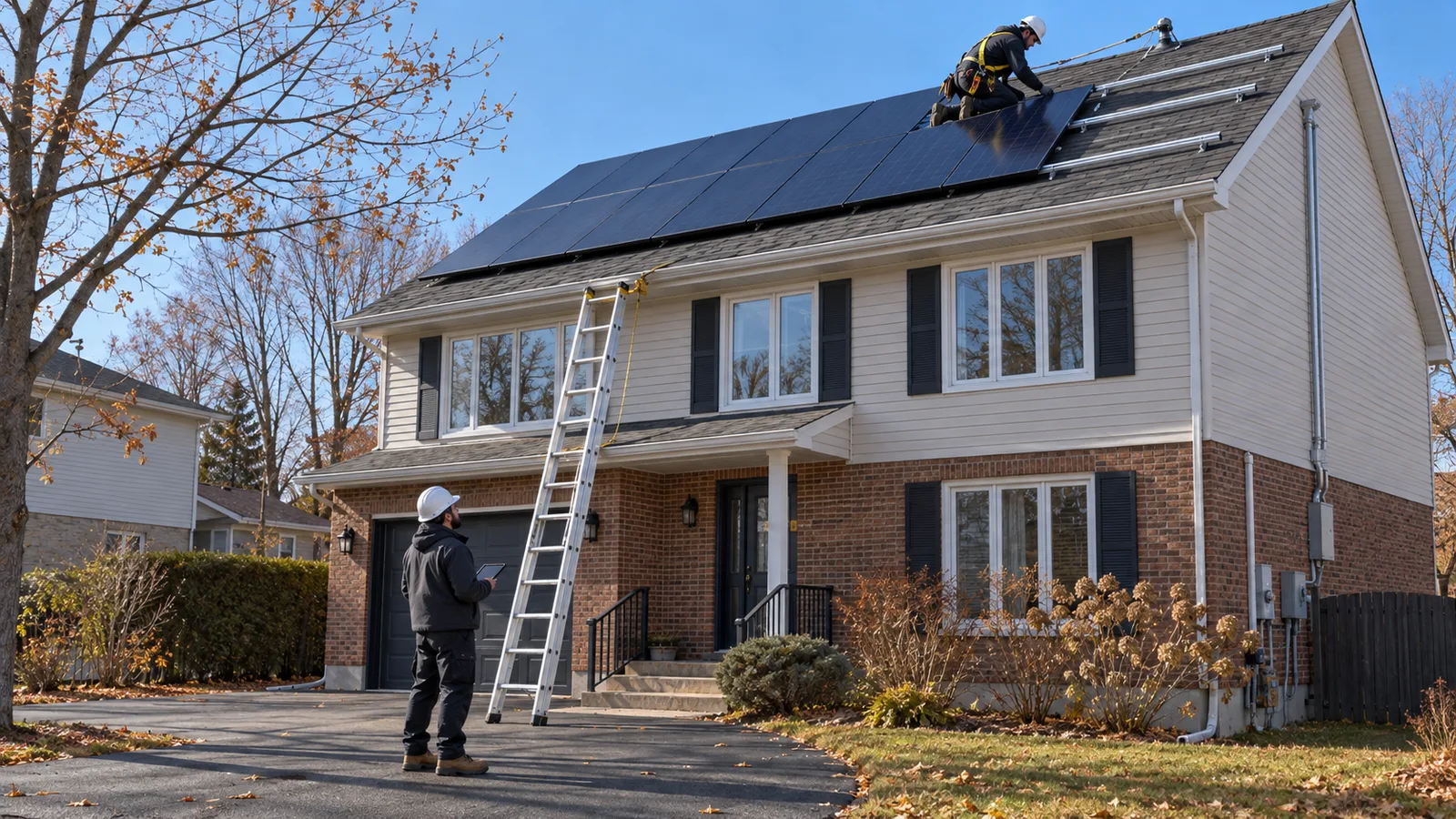
In short
STM-Électrique and solar
Based in Mirabel, STM-Électrique brings together master electricians who belong to the Corporation des maîtres électriciens du Québec, or CMEQ. Its RBQ licence 5815-0137-01 includes subclass 16 for electrical work, as well as subclasses 11.2 and 13.5: for installing the panels, Hydro-Québec’s solar subsidy requires one or the other. We install the solar panels ourselves, and we wire the inverter, along with the battery if you want one, to your electrical panel. The job also covers the Hydro-Québec connection request, from filing to final authorization, as well as the tests and the verification report signed by our master electrician. On the funding side, Hydro-Québec pays $1,000 per kilowatt installed for the panels, up to 40% of the purchase and installation cost; the battery falls under Rénoclimat instead, up to $4,000 toward the equipment. Every project is different: the exact price comes with a free written quote, by phone at 438 542-7304 or through the form at the bottom of the page.
Panels and battery: one system, one electrician
The panels produce electricity and the battery holds it in reserve: Hydro-Québec lists the first under “Production” and the second under “Storage” among its self-generation examples. Both fall under the same Hydro-Québec guide, the one for standard E.12-07, which covers solar installations as well as batteries.
Panels alone
Tied to the Hydro-Québec grid
- For its subsidy, Hydro-Québec requires a complete installation: panels, inverter, cables and racking, with a connection it approves.
- With net metering, what your panels produce in excess becomes credits in kilowatt-hours.
- Hydro-Québec subsidy: $1,000 per kilowatt installed, capped at 40% of the cost.
Panels with a battery
Energy kept for later
- The battery lets you use the electricity later, back up the circuits you choose, or both.
- For backup, a critical-loads panel groups the circuits to keep running.
- Hydro-Québec’s LogisVert subsidy excludes storage equipment; Rénoclimat can pay up to $4,000 toward the equipment of a fixed battery.
For the panels as for a grid-tied battery, the connection request goes through the master electrician. With us, installing the panels, the inverter and the battery is done under the same licence, and the connection request comes with it. The battery in detail, with its emergency panel: our home battery backup page.
What Hydro-Québec requires of your installation
Hydro-Québec sets conditions for the installation, and your house sets others. Here are the conditions to meet before a system is proposed.
- The capacity of the electrical panel. The inverter connects to it on its own breaker. A load calculation (in French) tells you how much more your panel can handle; the real calculation comes free with the quote.
- The meter and the Internet. Hydro-Québec requires a smart (communicating) meter and the option of connecting the Internet by Ethernet cable.
- Inverter power. The standard E.12-07 guide covers a 120/240 V installation whose inverters total 40 kW or less.
- System size. Under net metering, Hydro-Québec limits it to what it takes to cover some or all of your estimated needs, and to 1,000 kW at most.
- The roof and ownership. You must own the equipment and the place where it is installed. Roof repair or replacement is not covered by the solar subsidy.
Certified panels and inverter
Hydro-Québec sets standards for the two key parts of a solar installation: the panels, for its subsidy, and the inverter, for the connection.
The panels
LogisVert subsidy requirements
- New, and carrying CSA 22.2 No. 61730 and CSA 61215 certifications, or their UL or IEC equivalents.
- Bought in Québec: in a store, or online from a business that has an address there.
- Their certificates and data sheets are among the documents for the subsidy application.
The inverter
Connection requirements
- The standard E.12-07 guide calls for UL 1741-SB certification, compliance with IEEE 2030.5 and a neutral terminal.
- One of the inverters we install is CSA certified to C22.2 No. 107.1 and UL 1741.
- For that same inverter, the grid support functions were verified to UL 1741 SB and IEEE 1547.1-2020, as was its interoperability with the IEEE 2030.5-2018 protocol.
No uncertified equipment goes into your home, and we are not tied to a single supplier.
Based on Hydro-Québec’s residential LogisVert page (in French) and application guide for standard E.12-07 (in French, June 15, 2026 version), both checked October 15, 2026.
Hydro-Québec: we handle the connection request
When a project seeks the solar subsidy, Hydro-Québec reserves the final connection request for a master electrician. We file it, then follow up with Hydro-Québec until final authorization.
Hydro-Québec advises waiting for its conditional authorization before buying the equipment, and nothing is hooked up to the grid without its final authorization. In between, once the installation is in place, our master electrician runs the compliance tests and signs the verification report sent to Hydro-Québec. In the vast majority of projects, Hydro-Québec does not charge connection fees.
After that, net metering turns your surpluses into kilowatt-hour credits, not a payment. The credit bank is reset to zero every 24 months, and a positive balance is then applied as a credit on your bill. Every step, net metering and the subsidy documents: our guide solar panels and Hydro-Québec.
The rebates that apply
Two programs, two pieces of equipment: Hydro-Québec’s LogisVert for the panels, and the Québec government’s Rénoclimat for the battery.
The panels: LogisVert
Hydro-Québec
- $1,000 per kilowatt installed, capped at 40% of the purchase and installation cost; the guide sets no dollar ceiling.
- For a house (single-family, semi-detached, row, mobile or cottage), a multiplex or a residential building with 19 units or fewer.
- The installer must hold subclass 11.2 or 13.5 for the installation and 16 for the electrical work: our licence carries all three.
- Online application, once the official authorization is received, no later than nine months after the installation; according to the program guide, processing takes 10 to 12 weeks from receipt of a complete application.
- Excluded: the battery, roof repair or replacement, and replacing an existing photovoltaic system.
The battery: Rénoclimat
Government of Québec
- Up to $4,000 for the equipment if, among other conditions, the fixed battery is 5 kWh or more and stays connected to the panel and the grid; labour is not covered.
- Principal residence, or a building of four units or more, built and lived in for five years or more.
- For work done since October 1, 2026; we fill out and sign the contractor’s attestation form.
Can you get both on the same project? The programs do not confirm it. Rénoclimat does not allow combining its rebate with aid from the departments, agencies and Crown corporations of the governments of Québec and Canada, and LogisVert, once the subsidy is accepted, commits you not to submit any other subsidy application, to Hydro-Québec or to a government body, for the same equipment or the same work. We check that question with you at the quote stage, case by case.
All the battery conditions are in our Rénoclimat 2026 guide.
Sources consulted on October 15, 2026: LogisVert, residential (in French) and LogisVert participation guide (Hydro-Québec, in French), Rénoclimat participant’s guide (Québec.ca, in French).
What it costs
A solar system is a big project, and its cost depends on many things: every project is different, and it is the quote that gives its exact price. That quote is written and free.
What varies from one project to the next, and what the rebates cover or leave out: see our guide on solar and battery installation cost.
The rebates are calculated on what you pay: at most 40% of the purchase and installation cost of the panels for Hydro-Québec, and the lesser of the cap and the pre-tax equipment cost for the battery under Rénoclimat. Financing available through Financeit, subject to credit approval: see our Financing page.
From the visit to commissioning, step by step
The visit and the quote
We visit your home, then give you a written quote, free of charge.
Hiring your electrician
At Hydro-Québec, the first step belongs to the customer: hiring the electrical contractor who will connect the equipment.
The connection request
We file the request with Hydro-Québec, with the documents standard E.12-07 calls for: a signed single-line diagram and the inverter’s UL 1741-SB and IEEE 2030.5 certificates.
Conditional authorization
This is the green light to wait for before buying the equipment, as Hydro-Québec recommends. In an area where self-generation is already widespread, the request may be put on hold.
The permit and the declaration
The municipal permit, when the city requires one, is part of our job. We also declare the work to the Régie du bâtiment du Québec, when a declaration is required.
The installation
We install the panels ourselves, then connect the inverter and, where applicable, the battery, in line with the Québec Construction Code, Chapter V (Electricity).
The tests
Compliance tests: firmware, protection settings, neutral, with photos to back them up. The verification report, filled out and signed by our master electrician, then goes to Hydro-Québec.
Final authorization
Only after Hydro-Québec’s official acceptance is the disconnect closed and the installation connected to the grid.
Your rebate applications
LogisVert: online, after the authorization, no later than nine months after the installation. Rénoclimat, for a battery: no later than 12 months after the end of the work, with our attestation form. For Rénoclimat, the application portal is under development, announced for this fall; the work can already be done, and you keep the documents.
Solar panel installation in Laval, Montréal and on the North and South Shores
From our warehouse in Laval and our offices in Mirabel, we cover the area from Laval up to the Laurentians and from Montréal across to the South Shore.
Laval and the North Shore
Laval, Mirabel, Blainville, Saint-Eustache, Rosemère, Boisbriand, Terrebonne, Mascouche
Laurentians and Lanaudière
Saint-Jérôme, Sainte-Adèle, Sainte-Agathe-des-Monts, Mont-Tremblant, Lachute, Repentigny
Montréal and the South Shore
Montréal, Longueuil, Brossard, Boucherville and the entire South Shore
In Montréal, borough rules, plexes and flat roofs, and the Westmount exception: see our page on solar panels in Montréal.
Your city is not on the list? Leave your contact details and the team will confirm whether we can travel there.
If your home is served by a municipal or co-operative network rather than Hydro-Québec, LogisVert asks for other documents, including written authorization from the municipality or co-operative: mention it in your request.
Planning your project
Solar panels and Hydro-Québec
From the Hydro-Québec request to final authorization, then net metering and the LogisVert documents.
Rénoclimat 2026: battery and generator
The conditions of the battery measure, the documents to provide and the 12-month deadline.
Home battery backup
The fixed battery, its emergency panel and its connection to the electrical panel.
Load calculation (in French)
Is your electrical panel still big enough? A one-minute estimate, before the real calculation.
Electrical panel upgrade
Replacing or upgrading the panel, by our master electricians.
Financing
For homeowners: financing available through Financeit, subject to credit approval.
Solar panel installation: your questions
How many solar panels does a house need?
It depends on your energy needs: under net metering, Hydro-Québec limits the installation to what it takes to cover some or all of your estimated needs, and to 1,000 kW at most. The system is sized during the visit, and its exact price comes with the written quote.
How much does solar panel installation cost?
Every project is different: you get its exact price in a written quote, free of charge. Hydro-Québec’s subsidy can then reach $1,000 per kilowatt installed, capped at 40% of the purchase and installation cost of the panels.
How do grid-tied solar panels work with Hydro-Québec?
What the house does not use is fed into the grid; with net metering, those surpluses become credits in kilowatt-hours. The credit bank is reset to zero every 24 months, and a positive balance is then applied as a credit on your bill: Hydro-Québec does not pay you for your surpluses. Your equipment, for its part, must comply with Hydro-Québec standards E.12-01 and E.12-07.
Do solar panels need a battery?
No. Net metering credits your surpluses in kilowatt-hours without a battery, and Hydro-Québec’s LogisVert subsidy covers the panels and the inverter, not storage equipment. A battery lets you use the electricity later, keep circuits running during an outage, or both.
Is there a rebate for installing solar panels?
Yes, Hydro-Québec’s LogisVert: $1,000 per kilowatt installed, up to 40% of the purchase and installation cost. Among other things, you need new panels, certified and bought in Québec, an installer who holds the required RBQ licences, and a final connection request made by a master electrician. The battery is not eligible.
Who files the Hydro-Québec connection request?
Usually the electrical contractor: Hydro-Québec’s form is intended for the contractor, who fills it out on the customer’s behalf. Here, we file it ourselves, then follow up with Hydro-Québec until final authorization.
Do I need a permit for solar panels?
It depends on the city: Hydro-Québec’s standard E.12-07 warns that a municipal building permit may be required for solar panels. The municipal permit, when the city requires one, is part of our job.
Do you install the panels on the roof yourselves?
Yes, our team installs them. For its subsidy, Hydro-Québec requires the installer to hold subclass 11.2 or 13.5 for the installation: our licence carries both, plus 16 for electrical work. Roof repair or replacement is not covered by the solar subsidy.
Do you offer financing?
Yes: financing available through Financeit, subject to credit approval. Everything is explained on our Financing page.
Get a quote: solar panels
Your contact details, then three quick questions. Unsure of an answer? Choose “Not sure” or “Let’s discuss it” and we will check on site.
Solar panels and battery
A solar project?
A free written quote, then the Hydro-Québec connection request taken care of, through to final authorization.