Home generators · Master electricians
Home generator installation
When the grid goes down in the middle of January, it is not the unit that makes the difference, it is how it is connected to the house. STM-Électrique’s master electricians install the transfer switch, prepare the circuits to keep running and test everything by simulating a real outage, from Laval to the Laurentians and from Montréal to the South Shore.
Free written quote
4.9469 Google reviews- Master electricians, RBQ licence 5815-0137-01
- Portable or standby
- Outage test before we leave
In short
STM-Électrique and generators
STM-Électrique is a firm of master electricians based in Mirabel, holding RBQ licence 5815-0137-01. It connects residential and commercial generators: a portable unit plugged in through a power inlet and a manual switch, or a standby unit that starts on its own thanks to an automatic transfer switch. The job includes assessing the circuits to back up, the wiring, the declaration of work, the municipal permit if needed and a full switchover test. The quote is written and free: 438 542-7304 or the form at the bottom of the page.
A generator project? Three contact details and a few questions are all it takes.
Get a quoteFour ways to keep the power on during an outage
We always start with the same question: what has to keep running when Hydro-Québec goes down, and will someone be there to deal with it? The answer decides the setup.
A portable unit, properly connected
You already have the unit, or you want to keep it simple
We install an outdoor power inlet and a manual switch near the panel. On the night of the outage, you bring out the generator, plug in a single cable and flip the switch: the chosen circuits come back on, with no extension cord running through a window.
A standby unit that starts on its own
The house is protected even when you are away
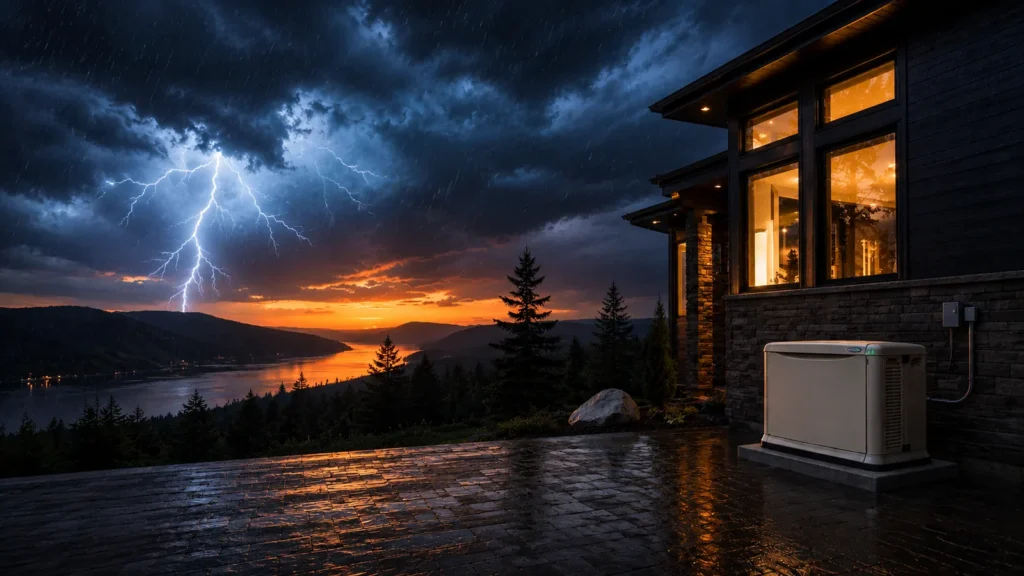
The unit lives outside, on its pad. The automatic transfer switch detects the loss of grid power, starts the generator and switches the circuits over in a few seconds, then switches back when power returns. We coordinate the fuel hookup with the trade responsible for it.
Backed-up circuit panel
When you do not want to back up the whole house
The priority circuits are grouped in an auxiliary panel: sump pump, furnace, fridge, a few outlets and lights. The generator only powers what matters, it is sized for those circuits, and you know exactly what works during the outage.
Businesses and small buildings
Walk-in cooler, alarm system, workstation
For a business, an outage costs lost stock and closed hours. We list the equipment that cannot stop, check the panel that feeds it and propose a backup system sized for that equipment only.
Rule number one
Why a generator is never plugged into an outlet
This is the most important rule on this page. Plugging a generator into the dryer outlet or a wall outlet with a “male-to-male” cable sends its power backwards: to the panel, then out to the grid. A line worker on a wire they believe is dead can then get a shock, and the unit itself can burn out when the power comes back.
The transfer switch solves the problem at the source: as long as the house is on the generator, it is physically separated from the grid. That is why it is mandatory, and why the hookup is a job for a master electrician, who declares the work to the Régie du bâtiment du Québec. Depending on the municipality, a permit may also be required. The technical details, manual or automatic, are explained in our transfer switch guide (in French).
- Never an extension cord into a house outlet. Not even for a few hours, not even “just the fridge” through the wall.
- Never a generator in the garage. Door open or not, exhaust fumes build up and get into the house.
- A working carbon monoxide detector. Check it before winter, not during the outage.
- Only one path for the power. The transfer switch, nothing else. If there is none yet, that is the first job to do.
Before the quote
What we check at your place before suggesting a unit
A fair quote is not done over the phone. Here is what a master electrician looks at during the visit, and why each point can change the price.
| What we look at | Why it matters |
|---|---|
| The circuits you want to keep running | This list sets the unit’s output and the size of the switch, far more than the size of the house. |
| How your home is heated | Electric baseboards or a heat pump need much more power than a gas furnace, which only needs electricity for its ignition, its fan and its controls. |
| The main panel | Its capacity, the space available and its condition decide whether the switch can go in as is, or a sub-panel or an upgrade is needed first. |
| The outdoor location | Distance from doors, windows and air intakes, the manufacturer’s clearances, and noise for you and your neighbour. |
| The fuel | Gasoline, propane or natural gas: the choice changes how long you can run during a long outage and which other trades need to be coordinated. |
| Your municipality’s requirements | Permits, where the unit is allowed on the lot, and distances: we check them for your address before starting. |
To compare outputs and fuels before our visit, read which generator for a home in Québec (in French). To see how the job goes and what changes the bill, see installing a generator: process and pricing (in French).
How your installation goes
Installing your generator panel, in four steps
- 1
Choosing the essential circuits
When we arrive, we go over your needs with you. We add or remove circuits depending on your generator’s output and the appliances you want to keep running. Example for a 60 A generator panel: one heating circuit, three lighting circuits and three outlet circuits. With a small generator, the oven and the electric water heater are usually left out. A 60 A panel does not mean the generator can deliver 60 A: its real output decides.
- 2
Installing the panel and the outdoor inlet
We mount the generator panel where planned, go through the wall to install the outdoor power inlet, run the wiring from that inlet to the transfer panel, then connect it to your main electrical panel.
- 3
Connecting the chosen circuits
We move the selected circuits to the generator panel and label them clearly. Normally they stay on Hydro-Québec power; during an outage, they run on the generator.
- 4
Testing and showing you
We check the connections and the transfer. If your generator and a compatible cord are on site, we run a test with the chosen circuits. Then we show you how to use your installation.
Where we work
Generator installation in Laval, on the North Shore, in Montréal and on the South Shore
Our offices are in Mirabel, in the heart of the northern suburbs. We connect generators everywhere STM-Électrique already works: each city below has its own page (in French), with what is specific to its homes and its area.
Laval and the North Shore
Laurentians and Lanaudière
Montréal and the South Shore
In the country, at a cottage or at the end of a back road, the generator often protects more than a fridge: a well pump, a septic system with a pump, a pellet stove that needs power to run. We include them in the circuit list from the first visit.
Our guides
To prepare your project before our visit (guides in French)
Which generator for a home
Portable or standby, output, propane, natural gas or gasoline: the criteria for choosing without paying for capacity you do not need.
Installation process and pricing
Who is involved and in what order, how long without power, and the items that make the bill go up or down.
The transfer switch
The part that isolates the house from the grid: manual or automatic, choosing the backed-up circuits, and a ballpark installed price.
Frequently asked questions
Generator installation: your questions
I already have a portable generator. Can you connect it to my house?
Yes. We install an outdoor power inlet and a manual transfer switch near the panel, then connect the circuits you want to keep running. First, we check that your unit’s output suits that list; if it does not, we tell you plainly what it can and cannot power.
How long does it take to install a generator?
It depends on the setup. Connecting a portable unit through a manual switch takes little work on site, with a power cut while the switch is wired to the panel. For a standby unit, the work on site is counted in days; the wait comes mostly from permits and the fuel hookup. We give you the schedule in writing with the quote.
Do I need a permit to install a generator?
For the electrical work, the master electrician declares the work to the Régie du bâtiment du Québec. Depending on the municipality and the fuel, a permit or other approvals may also be needed, especially for where the unit sits. We check the requirements for your address before starting.
Can a generator power the whole house?
It can if it is sized for it, but that is rarely the best choice, especially with electric heating. Most of our customers first back up what prevents damage or loss: sump pump, heating, fridge, a few outlets and lights. The options are detailed in our guide to choosing a generator (in French).
Do you install generators for businesses?
Yes. We list the equipment that must not stop, such as a walk-in cooler, an alarm system or workstations, check the panel that feeds them and propose a backup system for those loads. The approach is the same as for a house: visit, written price, outage test.
Which cities do you install generators in?
Everywhere STM-Électrique works: Laval, Mirabel and the North Shore, the Laurentians up to Mont-Tremblant, Lanaudière, Montréal and the South Shore. Our offices are in Mirabel. Tell us your city in the form and we will confirm the visit.
How do I get a quote for a generator?
Fill out the form at the bottom of the page or call 438 542-7304. Tell us whether you already have a unit, how the house is heated and what you want to keep running. A photo of the open panel helps us prepare the visit. The quote is written and free.
What do I do during a power outage?
With a generator panel and an outdoor inlet: 1. Place the generator outdoors, at least 6 metres from buildings, with the exhaust pointing away from doors and windows, never in a garage or shed. 2. Turn the backup circuit breakers OFF. 3. With the generator off, connect the compatible cord between the generator and the outdoor inlet. 4. Start the generator and let it stabilize as the manufacturer instructs. 5. Set the transfer switch to “Generator”. 6. Turn the chosen circuits back ON one at a time, staying within the available output. When power comes back: set the switch back to “Hydro-Québec” or “Utility”, let the generator run without load as the manufacturer instructs, stop it, then unplug the cord and close the inlet cover. Controls vary by model: follow your electrician’s demonstration and the manufacturer’s instructions.
Power out right now and something is wrong? See our 24/7 emergency service page or call us directly at 438 542-7304.
Generator
Ready for the next outage?
A visit, a clear list of the circuits to back up and a written price before the work.
Get a quote: generator
Your contact details and three or four quick questions. Not sure of an answer? Leave “Not sure” and we will check on site.