Home › Guides › Electrical panels
200 amp panel: is yours enough?
What a 200 amp panel really powers, when it gets tight, and why the Code doesn’t require anyone to install one.
In short
200 amps is the standard for recent construction, not a requirement. The Construction Code sets a minimum, 100 amps for most houses, but doesn’t impose 200 amps.
- On a 200 A service, the margin you can really use continuously is around 160 A.
- An EV charger, a heat pump, a hot tub and electric heating can use up that margin on their own.
- A full panel isn’t a maxed-out panel. The two are fixed differently.
- Only a load calculation, done by a master electrician, gives a reliable answer for your home.
Jump to a section7
What a 200 amp panel really powers
If you’re shopping for an EV charger, a heat pump or a hot tub, someone has probably already asked you: “how many amps do you have?” The most common answer in Québec is 200. And the next question almost always goes without a clear answer: is 200 amps enough for what you want to do?
This guide answers that, without shortcuts and without selling you an upgrade you may not need.
Let’s start with a distinction almost nobody makes, and which explains half the misunderstandings.
200 amps is the rated capacity of your service: what the main breaker lets through before it trips. It isn’t what you can use continuously without ever thinking about it.
In practice, an installation isn’t sized to run close to its maximum. Appliances that run a long time without stopping (a water heater, an EV charger, baseboards in January) are treated as continuous loads, and a reserve is kept. On a 200 A service, the real room to manoeuvre is around 160 amps.
That’s still a lot. In a typical house, it easily covers the range, the dryer, the water heater, the lighting, the outlets and the appliances. The problem never comes with what was planned at construction. It comes with what gets added afterwards.
The “200 amps required” myth
You often read that 200 amps has become mandatory, or that 100 amps is “no longer allowed”. That’s false, and it deserves to be said clearly.
The Québec Construction Code, Chapter V (Electricity), came into force in its 2026 version on March 26, 2026.
What this code says about the size of a house’s service: nothing. No section imposes 200 amps on a single-family home. What determines the capacity required is the load calculation, a standardized method that adds up the living area, the heating, the fixed appliances and the special loads of your house.
In practice, this calculation very often leads to 200 amps in a home built today. But it’s a result, not a rule. A 900 square foot house heated with gas can live perfectly well with less, and remain fully compliant.
What really changed in 2026 mostly concerns buildings: from five units up, Level 2 charging infrastructure must be planned for every parking space. And for everyone, the load of EV chargers must now be included in the load calculation that determines the capacity of the service.
In other words: the code doesn’t force you to go up to 200 A. But it forces your electrician to count your charger in the calculation, which, for many houses, amounts to the same thing.
The four loads that change the calculation
Four additions explain nearly all the upgrades we do on the North Shore and in Laval. Rarely alone: it’s adding them up that tips an installation over.
The EV charger. A residential Level 2 charger needs a dedicated 240 V circuit, usually sized between 30 and 48 amps depending on the model and the vehicle. It’s the heaviest addition an owner makes by choice, and it’s the one that must now appear in the load calculation.
The heat pump. A 12,000 to 18,000 BTU wall unit adds on without drama in most houses. A central heat pump, on the other hand, changes the equation, especially if the existing electric heating stays in place as backup, which is the norm in our climate.
The hot tub. An outdoor hot tub needs a dedicated circuit, suitable protection and equipotential bonding. Its consumption is intermittent but high, and it almost always comes at the worst time: winter evenings, when the heating is already running flat out.
Electric heating. It’s the dominant load in a Québec house heated with baseboards. It doesn’t show in the calculation the rest of the year, and it crushes everything in January.
| Added load | Typical circuit amperage | Effect on a 200 A service |
|---|---|---|
| Level 2 EV charger | 30 to 48 A | Significant, must be included in the calculation |
| Wall heat pump | 15 to 20 A | Low in most cases |
| Central heat pump | 20 to 40 A | Notable, especially with backup heating |
| Outdoor hot tub | 40 to 50 A | Notable, and concentrated in winter |
| Baseboard heating | Spread over several circuits | Dominant load in the cold season |
| Second electric vehicle | 30 to 48 A | Almost always needs load management |

How to tell if yours is maxed out
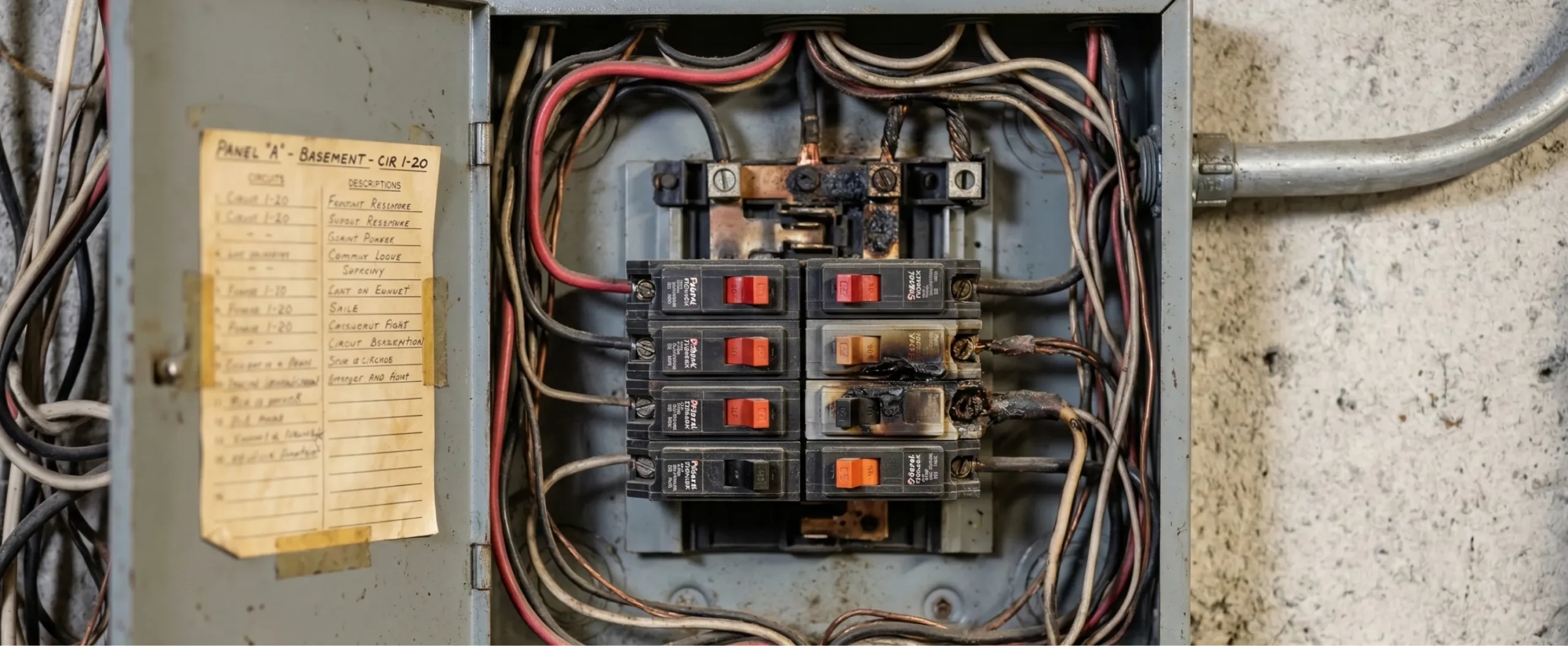
First of all: a full panel and a maxed-out panel aren’t the same thing. It’s the most common confusion, and it leads to unnecessary spending.
A full panel has no free slot left for a new breaker. It’s a physical space problem. It’s often fixed without touching the service: tandem breakers where the panel accepts them, or adding a subpanel.
A maxed-out panel already supplies more load than its capacity comfortably allows. It’s a capacity problem, and the available space changes nothing.
The signs worth checking:
- The lights dim noticeably when a large appliance starts. A slight variation is normal. A visible drop isn’t.
- The main breaker has already tripped. Not a circuit breaker: the main one. It’s the most direct signal.
- Breakers trip in winter only, when the heating adds to everything else.
- The panel is warm to the touch, or you hear a constant hum.
- The contractor who is to install your charger or hot tub asks for a load calculation before giving you a price. It isn’t a ploy: it’s what the code requires.
The only way to get a real answer remains the load calculation (in French). It takes into account the area, the heating method, the fixed appliances and what you want to add. It gives three possible outcomes: your service is fine, it’s fine with load management, or you need to go up.
A doubt about your installation?
We take a look, we price it, and the price is in writing before anything starts.
Send my quote requestHow many circuits in a 200 amp panel
The number of circuits depends on the panel model, not its amperage. For Siemens, the panel brand we install most often, the Canadian catalogue offers four sizes of 200 A panel with a main breaker:
| Siemens model (200 A) | Designation | What it means |
|---|---|---|
| SEQ24200 | 24/48 | 24 full-width breakers, or 48 half-width |
| SEQ32200 | 32/64 | 32 full-width breakers, or 64 half-width |
| SEQ40200 | 40/80 | 40 full-width breakers, or 80 half-width |
| SEQ60200 | 60/120 | 60 full-width breakers, or 120 half-width |
The first number counts standard breakers, one inch wide per pole. The second is the maximum with half-inch tandem breakers per pole. A two-pole breaker, the one for a 240 V appliance such as an EV charger or a range, therefore takes two full-width slots. Careful: some panels don’t accept tandems. The Siemens SEQ38200U, approved in both Canada and the United States, has 38 slots and only takes full-width breakers.
More slots doesn’t mean more capacity. A 60-slot panel is still a 200 A panel. If you’re short on space, tandem breakers (where the panel accepts them) or a subpanel often settle the question. If you’re short on capacity, only the load calculation says so.
The number of slots is chosen when the panel is replaced. That’s the time to mention what you plan to add: charger, heat pump, hot tub.
Source: Siemens Canada, load centre catalogue, May 2020.
When 200 amps is no longer enough
It happens, and less often than people think. The cases where 200 A is really exceeded:
- A large electrically heated house with two electric vehicles charging in the evening
- A workshop or detached garage with heavy tools or a welder
- An electrically heated pool on top of the hot tub and the heating
- A major addition with its own heating load
Before concluding that you need to go up, it’s worth looking at the two in-between solutions:
The load controller. It prevents two large loads from running at the same time, for example the charger and the dryer. For many houses, it avoids the upgrade entirely, for a fraction of the cost.
The subpanel. It fixes a lack of space without touching the capacity of the service. Useful when the problem is the number of circuits, not the total load.
If the calculation shows that more is really needed, we are then talking about a 320 or 400 amp service, which generally involves the whole service entrance, not just the panel.
Frequently asked questions
Does the Code require a 200 amp panel?
No. The Construction Code sets a minimum, 100 amps for most single-family homes, but no section imposes 200 amps. It’s the load calculation that determines the capacity required. In practice it often leads to 200 amps in recent construction, but it isn’t a regulatory requirement.
How many breakers can go in a 200 amp panel?
It depends on the model, not the amperage. For Siemens, the panel brand we install most often, 200 A panels with a main breaker have 24, 32, 40 or 60 full-width slots, and up to double with half-width breakers. The number of slots and the capacity of the service are two independent things.
Can I add an EV charger to my 200 amps?
In most cases, yes. Since 2026, the charger’s load must be included in the load calculation, and that calculation confirms whether your service handles it as is, whether load management is needed, or whether you need to go up. No serious electrician will answer you without doing that calculation.
How do I know how many amps I have?
The number is marked on the main breaker, at the top of your panel: 100, 125, 200. If the label is unreadable or you’re in doubt, don’t take anything apart: have it checked.
Is 200 amps enough for two electric vehicles?
Often yes, with smart load sharing that splits the power between the two chargers instead of running both at full power at the same time. Without that management, two chargers at full power weigh heavily on a 200 A service in an electrically heated house.
Does the service entrance have to be replaced along with the panel?
Not always. The panel and the service entrance are two different things: the service entrance is what runs from the grid to the meter. On an older property, the two often reach the end of their life together, and it becomes cheaper to do them at once. On a more recent house, the panel alone is often enough.
Will a bigger panel increase my Hydro-Québec bill?
No. Your bill depends on the energy used, not on the capacity available. A 200 amp service powering the same appliances as a 100 amp one costs exactly the same to run.
A doubt about your panel’s capacity?
Our master electricians do the load calculation before proposing anything. If your installation is fine as is, we’ll tell you.
4.9 from 549 Google reviews · RBQ licence 5815-0137-01 · CMEQ members · Free detailed quote
Get a quote: electrical panel
Sources
The figures and requirements cited in this guide come from the official pages below, consulted on September 11, 2026. Programs change: check the page’s update date before committing to any expense.
Read next
- Hot tub and pool wiring: what it takes
- Electrical panel upgrade in Québec: cost and how the day goes
- Is 100 amp service enough for your house?
- 200 amp service entrance (in French)
- 320 or 400 amp service: when to go past 200 amps
- Federal Pioneer Stab-Lok panels: what Québec homeowners should know
- Electrical panel upgrade
- Is your panel enough? The test (in French)