Home › Guides › Electrical panels
Is 100 amp service enough for your house?
A 100 amp service isn’t dangerous in itself. It becomes a problem when you ask more of it than it was sized for. Here’s how to tell.
In short
- A 100 amp service is still legal and safe if it’s properly sized for what it powers.
- The margin you can actually use continuously is around 80 amps, not 100.
- The problem almost always comes from additions (an EV charger, a spa, a heat pump), not from age.
- A full panel and a maxed-out panel aren’t fixed the same way, and they don’t cost the same.
- Only a load calculation gives you a real answer. Everything else is a clue.
In this guide
Many North Shore houses built between 1960 and 1990 have 100 amp service. Most of them still work just fine.
What changes is what we ask of them. An EV charger, a heat pump, a spa, a finished basement: every addition eats into the margin. The day the margin is gone, it isn’t the panel that got old. It’s the house that grew around it.
The five signs it’s reached its limit
None of these signs proves on its own that you need to move up. Together, they’re worth a call.
1. The main breaker has already tripped
Not a circuit breaker: the main one, the one at the top that shuts off the whole house. It’s the most direct signal there is. Your installation drew more than its capacity. A kitchen breaker that trips means an overloaded circuit. A main breaker that trips means the service itself.
2. The lights dim when a big appliance starts
A slight, brief dip when a compressor starts is normal. A visible drop across the whole house every time the dryer or the heat pump kicks in is not. It means the current draw is pulling the voltage down.
3. Breakers trip only in winter
This is the most misread sign. Everything is fine from May to October, then January becomes a struggle. The reason is simple: electric heating is the dominant load in a Québec home, and it stacks on top of everything else for four months.
4. There isn’t a single free space left
This one deserves an important nuance, and that’s the next section. A panel with no room left isn’t necessarily a panel at the end of its rope.
5. The contractor installing your EV charger asks for a load calculation
That’s not a sales tactic. Since 2026, the load of an EV charger must be included in the calculation that determines your service capacity. An electrician who quotes you a price without doing that calculation is selling you a risk.
| Sign | What it means | Urgency |
|---|---|---|
| The main breaker trips | The service is overloaded, not just one circuit | High: have it checked |
| Warm panel or constant buzzing | Loose connection or overheating | Immediate: don’t touch anything, call |
| Visible voltage drops | The current draw is straining the installation | High |
| Breakers tripping in winter | Heating is using up the remaining margin | Medium: fix it before adding anything |
| No free spaces left | A lack of space, not necessarily of capacity | Low: often solvable another way |
| Load calculation required for an addition | Normal procedure, not a bad sign | None: it’s the right thing to do |
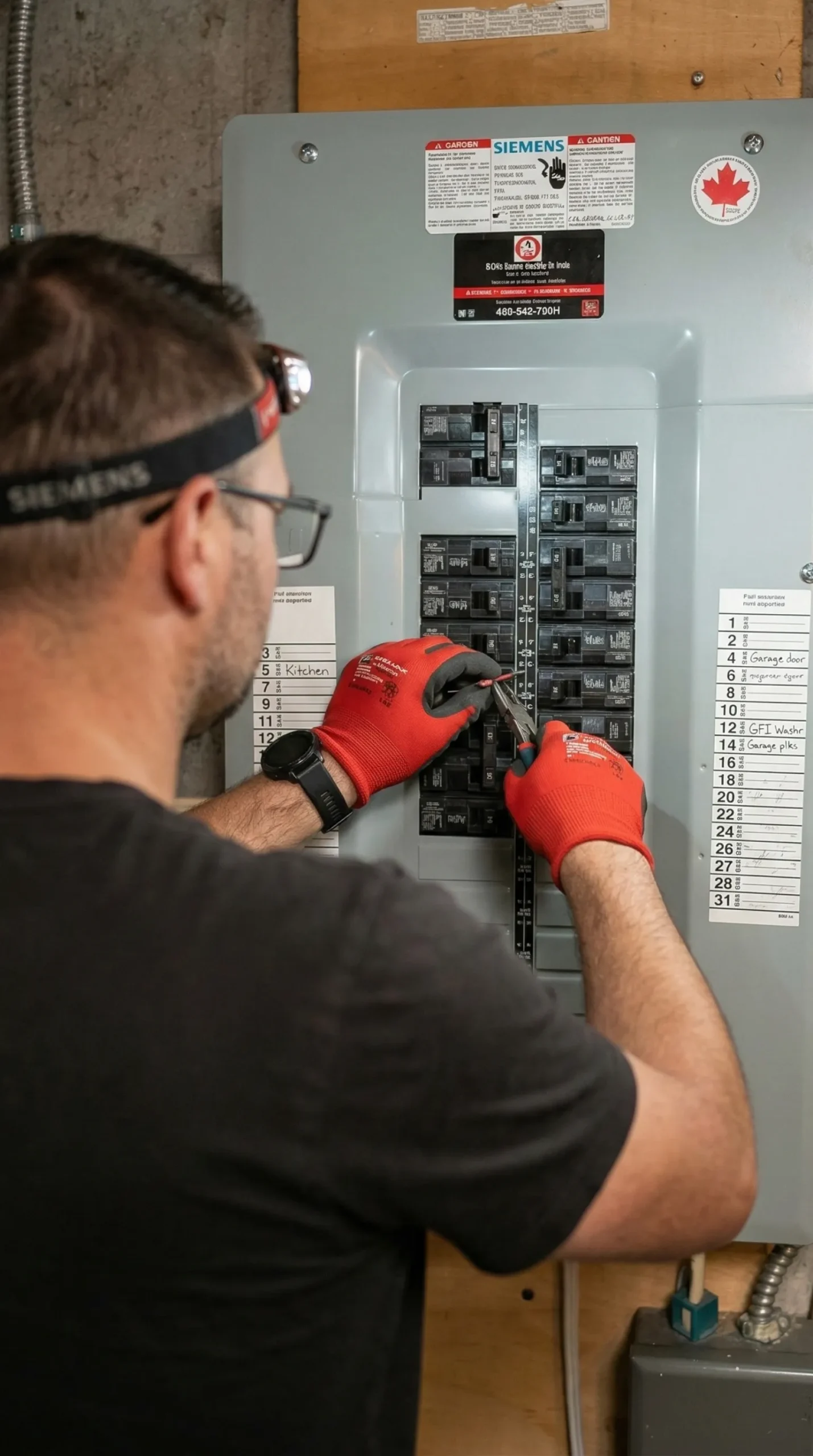
Full or maxed out: two problems, two bills
This is the mix-up that costs homeowners the most, because it leads them to pay for a full upgrade to fix a space problem.
A full panel has no free space left for a new breaker. It’s a physical limit. It can often be fixed without touching the service: tandem breakers where the panel accepts them, or a subpanel. You stay in the hundreds of dollars.
A maxed-out panel already feeds more load than its capacity comfortably allows. Free space changes nothing here: adding a space doesn’t create amps. Now you’re looking at an upgrade, which means thousands of dollars.
What a 100 amp service still does very well
We repair a lot of 100 amp panels. We replace fewer of them than people think.
So, is 100 amp enough for a house? A 100 amp service easily powers a modest-sized home with an electric range, a dryer, a water heater and the lighting. It also handles a home heated with gas or oil very well, because the heaviest load in our climate isn’t on the meter.
In practice, the margin you can actually use in continuous service is around 80 amps. A service isn’t run at 100% of its rating continuously. That 80 is what counts, not the number on the breaker.
In other words: if nobody in your home has added a big load in twenty years and nothing trips, your 100 amp service is fine. Age alone isn’t a reason to replace it.
The additions that tip it over
On a 100 amp service, small appliances are rarely the problem. It’s four loads, and they often show up along with a renovation project.
| Addition | Circuit amperage | Effect on a 100 A service |
|---|---|---|
| Level 2 EV charger | 30 to 48 A | Decisive: it’s the addition that triggers most upgrades |
| Outdoor spa | 40 to 50 A | Decisive, and concentrated on winter evenings |
| Central heat pump | 20 to 40 A | Significant, especially with electric backup heat |
| Finished, heated basement | Spread over several circuits | Significant, and often underestimated |
| Wall-mounted heat pump | 15 to 20 A | Low in most cases |
| Workshop or detached garage | Varies, often 60 A | Decisive if there are heavy tools |
One of these additions often fits. Two, rarely. And it’s almost always the second one that makes the difference.
Not sure about your installation?
We take a look, we price it, and the price is in writing before anything starts.
Send my quote requestUpgrading from 100 amp to 200 amp: what it really involves
When the calculation shows you need to move up, the 100 amp vs 200 amp question becomes concrete. Here’s what it means in practice.
It’s not just the panel. On a house built before 1990, going from 100 to 200 amps almost always involves the service entrance too: the mast, the meter base, the supply cable. The panel is the visible part of the job, not all of it.
Hydro-Québec is involved. Disconnection and reconnection are coordinated with the utility. The contractor takes care of it, but it’s also what can stretch the timeline.
It often requires a municipal permit, which the contractor applies for, and a declaration of the work to the Régie du bâtiment du Québec (RBQ), which may inspect it.
At STM-Électrique, for a single-family home, replacing the panel alone runs around $1,850, and a 100 amp to 200 amp upgrade with a new service entrance runs around $2,900. These are ballpark figures for a typical house. The distance between the panel and the meter, the number of circuits and the condition of the service entrance all change the bill. Nobody can give you a firm price without seeing the place.
Frequently asked questions
Is a 100 amp panel dangerous?
No, not in itself. What’s dangerous is an overloaded installation, a loose connection or a panel model with known defects. Amperage isn’t a measure of safety. It’s a measure of whether the service is enough.
Do I need to upgrade to 200 amps?
Only if the load calculation shows it. If nothing trips, you’re not adding anything and the lights don’t dim, your 100 amp service is doing its job. Upgrading “just in case” is an expense, not a precaution.
Can I just add a subpanel?
If your problem is a lack of breaker spaces, yes, and it’s often the right solution. If your problem is capacity, no: a subpanel redistributes the amps you already have, it doesn’t create any.
Does my 1975 house necessarily have 100 amps?
No. It was common, not universal, and many houses have been upgraded since. The number is printed on the main breaker, at the top of the panel. If the label is unreadable, don’t take anything apart: have it checked.
Can I install an EV charger on 100 amp service?
Sometimes, yes, with a charger sized accordingly or with load management. But the calculation decides, and the charger must now be included in it. Be wary of an installer who says yes without calculating anything.
Can my insurer cause problems?
An insurer generally isn’t interested in the amperage, but in the type of panel, whether there are fuses and the condition of the installation. A 100 amp service in good condition and well documented usually isn’t a problem. Keep your work reports: that’s what you’ll be asked for.
How long does the upgrade take?
Half a day to a full day without power in most cases, longer if the service entrance is redone at the same time. You get the exact window before the work starts.
Has your 100 amp service reached its limit?
We do the load calculation before we propose anything. If your service works as is, we’ll tell you, and finding out won’t cost you anything.
4.9 from 469 Google reviews · RBQ licence 5815-0137-01 · Members of the Corporation des maîtres électriciens du Québec (CMEQ) · Free detailed quote
Sources
The figures and requirements cited in this guide come from the official pages below, consulted on September 11, 2026. Programs change: check the page’s last update date before you commit to any expense.