 CAA Habitation recommended
Service entrance · Master electricians
Electrical tripod on a flat roof
Your flat-roof tripod is damaged? We usually replace it; otherwise, we run your service entrance through conduit, as the Code allows. We handle the steps with Hydro-Québec.
24/7 emergency: 438-542-7304
4.9580 Google reviews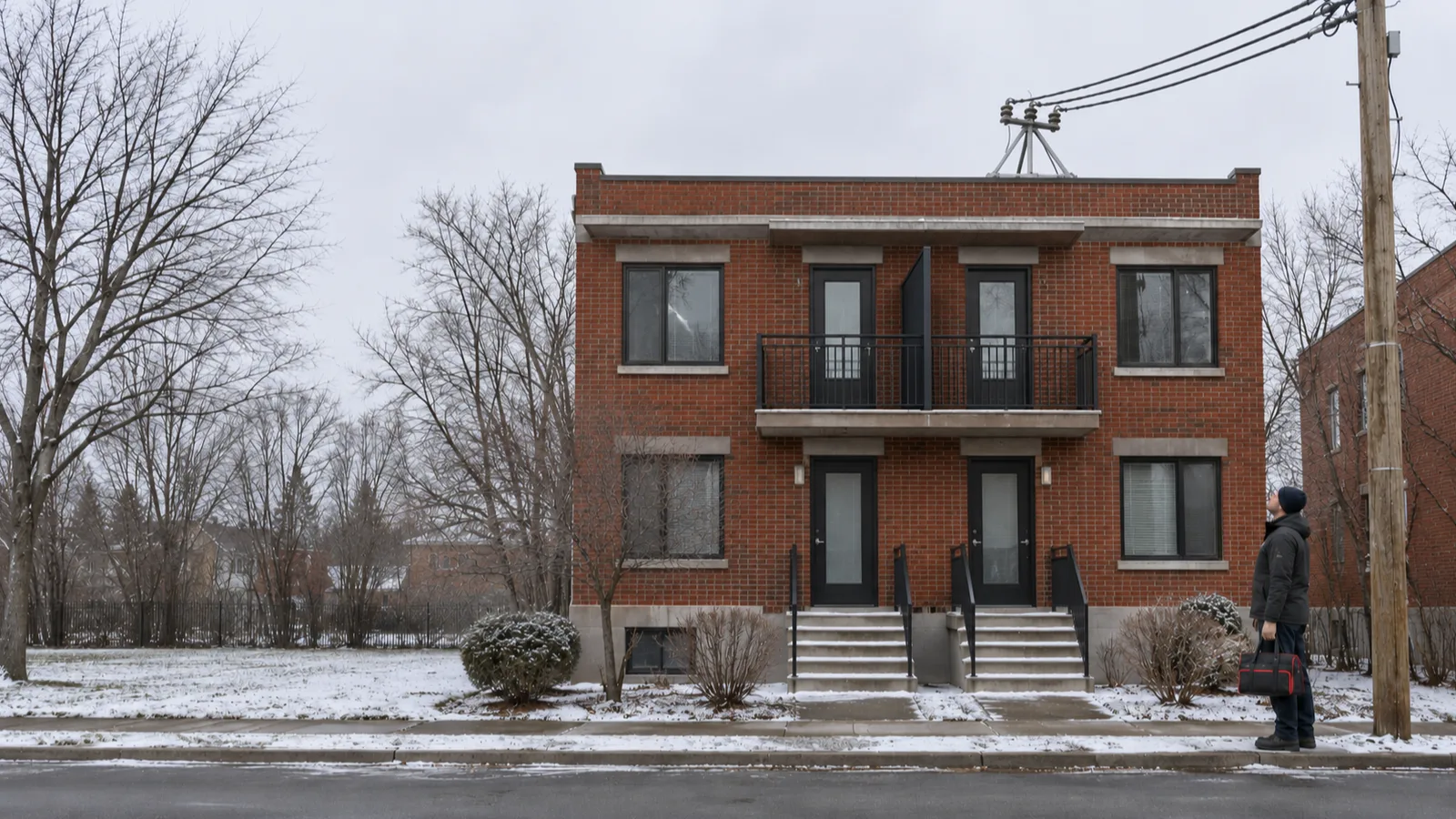
In short
Damaged tripod: replaced, or converted to conduit
A damaged tripod, we usually replace; otherwise, we convert your service entrance to a conduit system.
What the 2026 Code allows on site decides the option: it limits exposed conductors on the outside surfaces of the building, and it has been in force since March 26, 2026, with a transition period until October 17, 2027.
We handle the steps with Hydro-Québec. For emergencies, day or night: 438-542-7304.
A wire down or hanging? Call 911
Hydro-Québec is clear: a wire on the ground, cut or hanging at head height is dangerous, even if it looks still and silent.
Call 911, stay more than 10 metres from the wire and tell others not to approach. No sparks does not mean no voltage.
On the roof or on the ground, bring no tool near the wires, not even to measure.
The tripod and the standard’s rooftop support
The tripod on your roof is what Hydro-Québec’s standard calls a rooftop support structure. Standard E.21-10 (Blue Book, 10th edition, updated February 2021) defines it as a metal support fitted with insulators and installed on the roof of a building.
On an existing rooftop support structure 8 metres or less above grade, the connection point is on top of the structure. Hydro-Québec connects its service loop there if at least 1 metre separates its wires from the parapet wall, and if the point is no more than 1 metre from the edge of the roof.
Higher than 8 metres, the connection is made at a spool rack instead, or at the supply point, if the customer provides the service up to it by agreement with Hydro-Québec.
What the 2026 Code changes
Chapter V of the Québec Construction Code, edition C22.10:26, has been in force since March 26, 2026, with a transition period until October 17, 2027.
Its Québec amendment to Rule 6-302 limits existing rooftop supports: exposed conductors remain allowed there only to repair or replace the conductors, and only if nothing else about the service entrance changes.
The Régie du bâtiment du Québec (RBQ) adds that an existing rooftop support must also comply with Rule 12-314 to be reused.
Elsewhere on the outside surfaces of the building, no exposed conductors on the supply side of the service head: they run in rigid conduit, steel electrical metallic tubing or a cable type listed in the Code.
A house where the work started before October 17, 2027 may have followed the previous version of the Code.
Replace it or switch to conduit
Our approach comes down to two cases: a damaged tripod, we usually replace; otherwise, we convert the service entrance to conduit. What the Code allows on site decides the rest.
With conduit, the conductors are no longer exposed, as the Code requires away from existing rooftop supports. Hydro-Québec’s standard also sets rules for the support that holds the spool rack:
- Accepted masts: prefabricated metal masts and rigid steel conduit of 63 mm or more, secured with three mast clamps.
- Mast-mounted spool rack: at least 915 mm above the roof, with the bottom of the drip loop at least 600 mm above it.
- No vertical PVC section above a roof unless an angle iron or a mast supports it along its full length.
- Spool rack 8 metres or less above grade, except for existing installations.
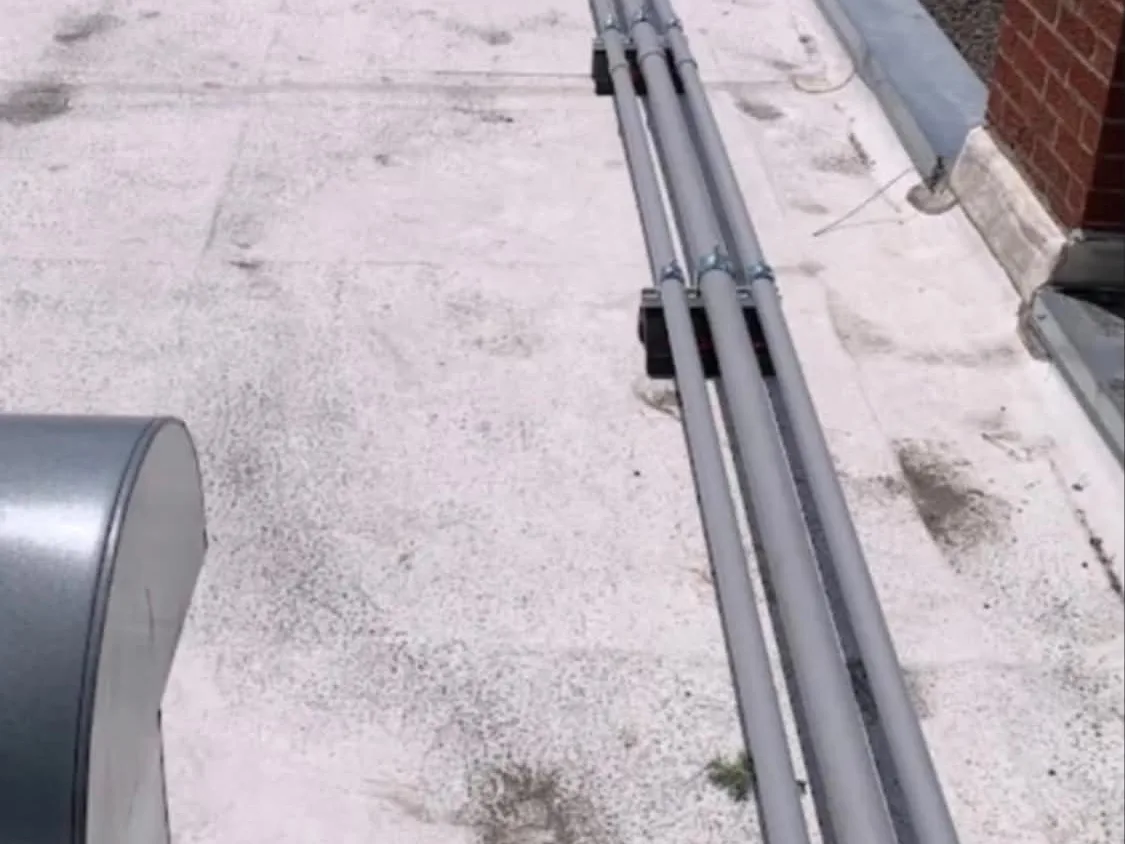
Conduits on supports along a flat roof.
Who does what: you, us, Hydro-Québec
Hydro-Québec supplies and installs its service loop up to the connection point, and keeps ownership of it. What comes after that point, up to the service box, is part of your installation; on an existing rooftop support 8 metres or less above grade, that point is on top of the structure.
Only Hydro-Québec works on its line and at the supply point. When the service entrance is modified or renovated, at 120/240 V and 200 amps or less, a master electrician may disconnect and reconnect the overhead service loop, with Hydro-Québec’s prior permission; after an unforeseen event, that permission may follow the work.
If the storm damaged Hydro-Québec’s own service loop, the master electrician does not touch it; they may repair damaged connections at the connection point.
Only a CMEQ member may do this work and send the declaration of work to Hydro-Québec.
After a storm
In a major event, Hydro-Québec first restores power to as many customers as possible; individual service loops come among the last steps.
If something you own is damaged, Hydro-Québec will not reconnect before it is repaired. For your installation, call us first: 438-542-7304, day or night.
A rushed repair can be costly: a third party or customer who damages Hydro-Québec’s line while repairing after an unforeseen event may be billed for it.
A torn-off mast rather than a tripod? See electrical mast repair.
Montréal, Laval, North Shore and South Shore
Our master electricians work in Montréal, Laval, the North Shore and the South Shore. Who pays for what between the house and the grid: mast, meter base, meter; for a full service entrance: electrical service upgrade.
Flat-roof tripod: your questions
What is an electrical tripod on a flat roof?
It is the support that Hydro-Québec’s standard calls a rooftop support structure: a metal support fitted with insulators, with the connection made on top when it is 8 metres or less above grade.
Can an old tripod be kept?
Since a tripod is what the standard calls a rooftop support structure, the 2026 Code limits it too: it restricts existing rooftop supports to repairing or replacing the conductors, with no other change to the service entrance; the RBQ also requires them to comply with Rule 12-314. A house where the work started before October 17, 2027 may have followed the previous version of the Code.
Who pays to reinforce the support?
The customer: the standard asks the master electrician to secure the spool rack, mast and service entrance, and to reinforce them as needed, at the customer’s expense.
Do I need to call Hydro-Québec?
For your installation, we handle the steps. A wire down or hanging: call 911 and stay more than 10 metres away.
Who can do this work?
A CMEQ member: only they may do the work and send the declaration to Hydro-Québec.
How much does a replacement cost?
The price depends on what needs redoing; it is in the written quote, at no charge.
Get a quote: flat-roof tripod
Your contact details and a few quick questions. Not sure of an answer? Leave “I don’t know” and we’ll check on site.
Service entrance
A damaged tripod on your roof?
Call us day or night, or ask for a written quote at no charge.