 CAA Habitation recommended
Home › Guides › Electrical panels
200 amp service upgrade: what to know
The mast, the meter base, the cable, the meter: everything between Hydro-Québec’s grid and your panel, who owns it, and what replacing it costs.
In short
The service entrance is not the panel: it’s everything from the grid to your service box.
- Part of it belongs to Hydro-Québec; the mast and the meter base belong to you.
- On a house at 200 amps or less, the master electrician can disconnect and reconnect it, with Hydro-Québec’s prior authorization.
- Overhead or underground changes the cost and the look, not the capacity.
- It’s very often redone at the same time as the panel, and it costs less that way.
- Redone with the panel on a single-family home, the service entrance has its price in the written quote, free of charge.
Jump to a section7
What a service entrance includes
Many people call “service entrance” what is actually the panel. The confusion is understandable, and it’s expensive: the two aren’t replaced the same way, don’t cost the same and don’t involve the same people.
This guide covers everything that is outside, from the grid to your service box. What happens inside the panel is covered in another guide.
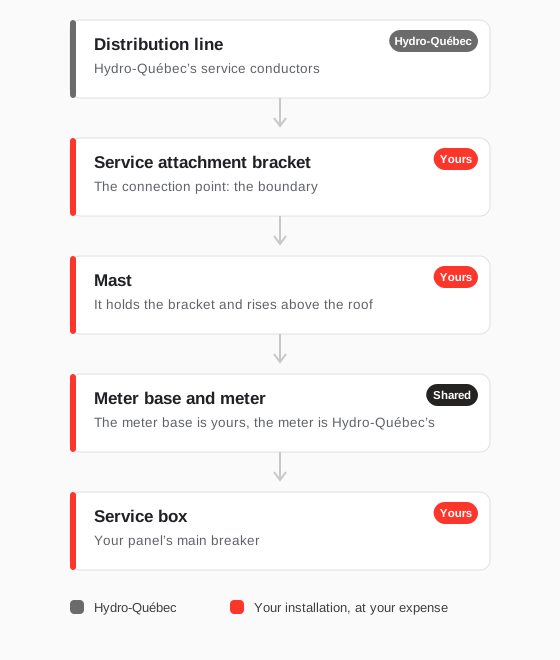
A residential overhead service entrance, starting from the street:
- Hydro-Québec’s service conductors, run from the line to your house
- The service attachment bracket, the metal fitting with insulators the conductors are attached to
- The mast, the metal tube that rises above the roof and holds the bracket
- The customer’s service conductors, which come down from the mast to the meter
- The meter base, the metal box the meter plugs into
- The meter itself
- The cable from the meter base to the service box, your panel’s main breaker
That’s where the service entrance stops and the panel begins.
The figure “200 amps” is the capacity of that whole path. A 200 A panel fed by a service entrance sized for 100 A is still a 100 A installation. That’s why you can’t just “upgrade the panel” on its own on an older house.
The exact line between you and Hydro-Québec
This line isn’t a grey area: it’s written in Standard E.21, the document known as the “Blue Book”, which governs low-voltage customer connections.
The marker is called the connection point, and it’s at the service attachment bracket. Hydro-Québec supplies, installs and remains the owner of its service conductors up to that point. Everything after it (the bracket itself, the mast, the conductors coming down, the meter base, the cable to the service box) is part of your electrical installation, and an electrical contractor replaces it, at your expense.
| Part | Who owns it | Who replaces it |
|---|---|---|
| Distribution line and conductors up to the connection point | Hydro-Québec | Hydro-Québec |
| Service attachment bracket | You | The master electrician, at your expense |
| Service mast | You | The master electrician, at your expense |
| Customer’s service conductors | You | The master electrician, at your expense |
| Meter base (the meter’s box) | You | The master electrician, at your expense |
| Meter | Hydro-Québec | Hydro-Québec: opening the meter base is reserved for it |
| Cable from the meter base to the service box | You | The master electrician, at your expense |
In other words, almost everything you can see on your wall belongs to you. The meter is the exception, and its housing, the meter base, is yours even though the device inside it isn’t.
Overhead or underground
An overhead service entrance comes through the air from a pole. It’s the most common setup on the North Shore and in Laval. It costs less to install and is simpler to repair, but it’s exposed: ice, branches, wind.
An underground service entrance comes in through a buried conduit. It’s invisible, sheltered from the weather, and it’s the norm in newer neighbourhoods where distribution is already underground. On the other hand, it costs more to install because digging is needed, and any future work means opening the ground again.
The point to remember: this choice has no effect on capacity. A 200 amp underground service and a 200 amp overhead service power exactly the same house. What changes is the cost, the look and the exposure to the weather.
Switching from overhead to underground is possible, but it isn’t a simple change: it depends on how the grid is laid out on your street, the distance to cover and what has to be crossed. It takes an assessment on site, never an answer over the phone.
Unsure about your service entrance?
We take a look, we price it, and the price is in writing before anything starts.
Send my quote requestSteps and timelines
Here is the part most owners don’t know, and it changes the whole schedule.
On a house supplied at 120/240 V at 200 amps or less, the standard allows the master electrician to disconnect Hydro-Québec’s overhead service, move it or shorten it, then reconnect it, with Hydro-Québec’s prior authorization and under certain conditions: the service must not cross a public road, the connection point must not be on a line pole, and it must be at least three metres from the distribution line.
That’s why an ordinary residential service entrance is redone in one day, without waiting for a Hydro-Québec crew to be free. Beyond 200 amps, or when these conditions aren’t met, Hydro-Québec has to step in, and the schedule is no longer ours.
The usual steps:
- Before: visit, load calculation, quote, municipal permit if your city requires one, and the service request and declaration of work form sent to Hydro-Québec
- On the day: power cut, removal of the old mast and meter base, installation of the new ones, new cable pulled, connection to the panel, power restored
- After: the inspection provided for by the regulations, and handover of the work report
On the power cut: usually about 6 hours. You get the exact window before the work.
How much does it cost to upgrade to 200 amp service?
At STM-Électrique, the price is in the quote, which is written and free.
- Service entrance and panel redone together, on a single-family home: price in the quote.
- Panel alone, if the service entrance is sound: price in the quote.
- Underground service (overhead-to-underground): price in the quote, excluding excavation and the pole. The private pole and the excavation are extra.
- Hydro-Québec’s fees for the underground service: extra, billed directly by Hydro-Québec.
The details on underground service are on our page underground electrical service.
What changes the bill
At STM-Électrique, the price of redoing the service entrance and the panel together on a single-family home is in the written quote, free of charge. Here is what changes the price.
- The distance between the meter and the panel. Three metres or fifteen isn’t the same cable or the same time.
- Overhead or underground. Excavation changes the size of the job.
- Height and access. A mast on a steep roof isn’t replaced like a mast on a bungalow.
- The condition of the rest. If the panel follows, it’s a second part of the project, and it almost always is.
- The municipal permit, whose cost varies from one city to another.
- What we find when we open things up: non-compliant wiring, a meter base corroded deep inside, a wall to repair.
Service entrance and panel: together or separately
When both are at the end of their life, doing them together costs much less than two separate jobs: one disconnection, one permit, one mobilization, one inspection.
When the service entrance is sound and only the panel’s capacity is the problem, we don’t touch the service entrance. The inspection decides, and an honest quote tells you which of the two situations is yours.
Frequently asked questions
What’s the difference between the service entrance and the panel?
The service entrance is everything that brings electricity from the grid to your service box: conductors, bracket, mast, meter base, meter, supply cable. The panel is the breaker box that then distributes that electricity through the house. The service entrance is outside, the panel is inside.
How long will I be without power?
Usually about 6 hours, because on an installation of 200 amps or less the master electrician can disconnect and reconnect it. Beyond 200 amps, the timing depends on Hydro-Québec.
Do I need a permit?
It depends on the city: some require one for a service entrance, others don’t. When one is needed, we apply for it, and the declaration of work is sent to Hydro-Québec. You have nothing to do with your city.
Who calls Hydro-Québec?
The contractor. They send the service request and declaration of work form and get the prior authorization. You have no calls to make.
Can I switch from an overhead to an underground service?
Often yes, but it depends on how the grid is laid out on your street, the distance to dig and what has to be crossed. The cost is much higher than an overhead replacement. It’s decided after a visit, not over the phone.
How long does a service entrance last?
There’s no expiry date. What ages it is the weather, corrosion at the meter base and mechanical stress on the mast. A well-installed, protected service entrance lasts for decades; one exposed to water and ice deteriorates much faster. A visual inspection decides, not age.
Can I replace the service entrance without replacing the panel?
Yes, when the panel is in good condition and has enough capacity, for example after a broken mast. The reverse is rarer: raising the panel’s capacity without touching an undersized service entrance achieves nothing, because the weakest link sets the real capacity.
How much does it cost to upgrade to 200 amp service?
Often redone with the panel on a single-family home; price in the quote. Underground, the excavation and the pole are extra, and so are Hydro-Québec’s fees, billed by Hydro-Québec; the price is in the quote.
A service entrance to assess?
We look at the mast, the meter base, the cable and the panel together, we handle the permit and Hydro-Québec, and you know what it costs before it starts.
4.9 from 469 Google reviews · RBQ licence 5815-0137-01 · CMEQ members · Free detailed quote
Get a quote: service entrance
Sources
The figures and requirements cited in this guide come from the official pages below, consulted on September 11, 2026. Programs change: check the page’s update date before committing to any expense.
Read next
- Grounding a house: what it is, when to redo it
- Mast, meter base, meter: who pays for what
- Electrical panel upgrade in Québec: cost and how the day goes
- Is 100 amp service enough for your house?
- Our service entrance services
- Is your panel enough? The test
- Outdoor electrical panel: what Québec’s code allows
- Service entrance replacement in Montréal
- Service entrance replacement on the South Shore
- Service entrance replacement in Laval