 CAA Habitation recommended
Free tool · Panel and service entrance
Panel only or service + panel?
Four questions about your panel, your plans and what you see outside: the test tells you whether the panel alone is involved, whether the service entrance is too, or whether the load calculation decides.
4.9469 Google reviewsThe tool
Your answers
Your result
Start with the first question.
Your result
Have the service entrance assessed, the panel depending on its condition
A recent panel with enough capacity stays: only the service entrance is redone. On a house built before 1990, both are often at the end of their life at the same time, and one job costs far less than two.
A leaning mast doesn’t fix itself: every storm makes it worse.
A rusted meter base lets water in: have it looked at soon.
Your result
Service + panel, most of the time
A 60 amp service dates from before the 1960s: when it’s replaced, the service entrance goes with the panel almost every time.
Your result
Service + panel, most of the time
When a fuse panel comes out, the service entrance often has to be redone with it.
Your result
A subpanel may be enough
If all you lack is room for breakers, a subpanel often solves it. If you lack amps, it solves nothing: it shares the ones you already have.
Your result
The load calculation decides
On 100 amps, it isn’t age that tips it over, it’s the big additions.
A charger can fit on 100 amps, sized accordingly or with load management, but only if the calculation confirms it; the charger must now be counted in it.
And enlarging the panel without enlarging an undersized service entrance does nothing: the weakest part sets the capacity of everything else.
Your result
The load calculation decides
A main breaker that trips often signals a lack of amps, but a fault on a single circuit can trip it too. The load calculation tells the two apart.
Your result
Your 200 amps is often enough
Most of the time, a charger fits on 200 amps. Since 2026, it must be counted in the load calculation, which tells you whether it fits as is, with load management, or whether you need more.
Your result
The load calculation decides
200 amps isn’t a guarantee: the load calculation, with your additions, tells you whether it’s enough.
Your result
Your 100 amps is probably doing its job
Nothing trips, nothing to add, the lights hold steady: your 100 amps is enough. Replacing it “just in case” costs money without protecting you any more.
Your result
First, read the main breaker
Open only the panel door: the amperage is written on the big breaker at the top. Unreadable? Don’t take anything apart, have it checked.
Your result
The visit decides
The visit decides.
Our master electrician confirms the calculation on site.
The test points the way; the visit confirms it, and the quote costs nothing.
Good to know
Does a bigger service increase my electricity bill? No. Capacity consumes nothing.
Do I need to replace the panel at the same time? Not always, but often. On an older house, the service entrance and the panel frequently reach the end of their life together.
Panel, service entrance, or both?
Our master electricians do the load calculation at the visit and replace the panel, the service entrance, or both at once.
The service entrance and the panel: two things
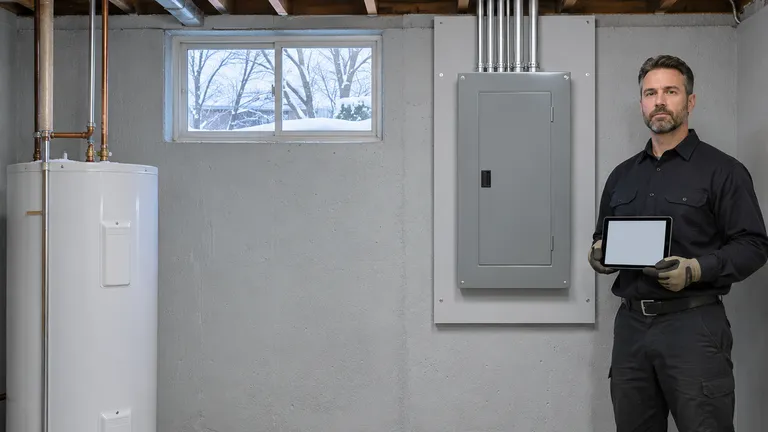
The service entrance is what brings power from the grid to your house: the bracket, the mast, the meter base, the meter and the cable. The panel is the breaker box that distributes that power through the house. One is outside, the other inside, and one can be replaced without the other. To see each part, open the service entrance diagram.
How the test decides
The test reads your answers in a set order. First what you can see outside: a leaning mast or a rusted meter base put the service entrance in question, whatever the panel. Then old services: at 60 amps or with fuses, the replacement almost always takes the service entrance along with the panel.
Then the difference between running out of room and running out of capacity, and finally your plans: an EV charger, a heat pump or a spa on 100 amps, it’s the load calculation that says whether it fits. The test doesn’t replace that calculation; it tells you where to start.
A full panel or a maxed-out panel
A full panel has no free space left for a breaker; a maxed-out panel has no capacity left to give. The first is often solved with a subpanel. The second isn’t: a subpanel shares the amps that already exist without adding any. That’s why the test asks what happens in the house before concluding.
To go further: is 100 amp service enough?, 200 amp service and the load calculation.
Quote: panel, service entrance or both
Your test answers come with the request. The load calculation is confirmed on site, then you get a written quote, free of charge.
Our other tools
Frequently asked questions
What’s the difference between the service entrance and the panel?
The service entrance brings power from the grid to your service box; the panel distributes it through the house. The service entrance is outside, the panel is inside.
Do I need to go to 200 amps?
Not necessarily. 200 amps is the standard for recent construction, not a requirement: the load calculation determines the capacity your house needs.
Does a subpanel add amps?
No. It solves a lack of breaker spaces, not a lack of capacity: it shares the amps you have without creating any.
Does a bigger service raise the electricity bill?
No. Capacity consumes nothing: it’s what you plug in that makes the bill, not the size of the service.
Should the service entrance and the panel be replaced at the same time?
Not always, but often. If the panel is recent and has enough capacity, we only touch the service entrance; on an older house, the two often reach the end of their life together.
Sources
- RBQ, Construction Code update, March 12, 2026 (in French)
- CMEQ, Construction Code, Chapter V, Electricity 2026 (in French)
- Hydro-Québec, standard E.21, low-voltage electricity service (PDF, in French)
- Hydro-Québec, Conditions of Service (PDF)
Sources consulted for our panel and service entrance guides; tool published on November 6, 2026.
Master electricians · 24/7
A project or an emergency?
Free, detailed quote. For an emergency, we answer 24 hours a day.